
The Graph Threshold
Human Society, AI, and the Economic Transition from Nodes to Graphs
This paper explores a potential transition point in human society where economic value increasingly shifts away from isolated human “nodes” toward highly connected intelligence “graphs.”
The central thesis is:
There exists a threshold of intelligence coordination where graphs can primarily communicate with and create value for other graphs faster, cheaper, and more effectively than humans operating as independent economic units.
At this threshold, traditional human labor structures begin losing direct economic value unless humans become integrated into larger intelligence networks.
The paper proposes that April 2026 may represent an early symbolic marker of this transition era — not because of a single event, but because of the accelerating convergence of:
- large-scale AI systems,
- graph-based intelligence architectures,
- autonomous coordination,
- machine-to-machine interaction,
- and declining marginal value of isolated human cognition.
1. The Diagram
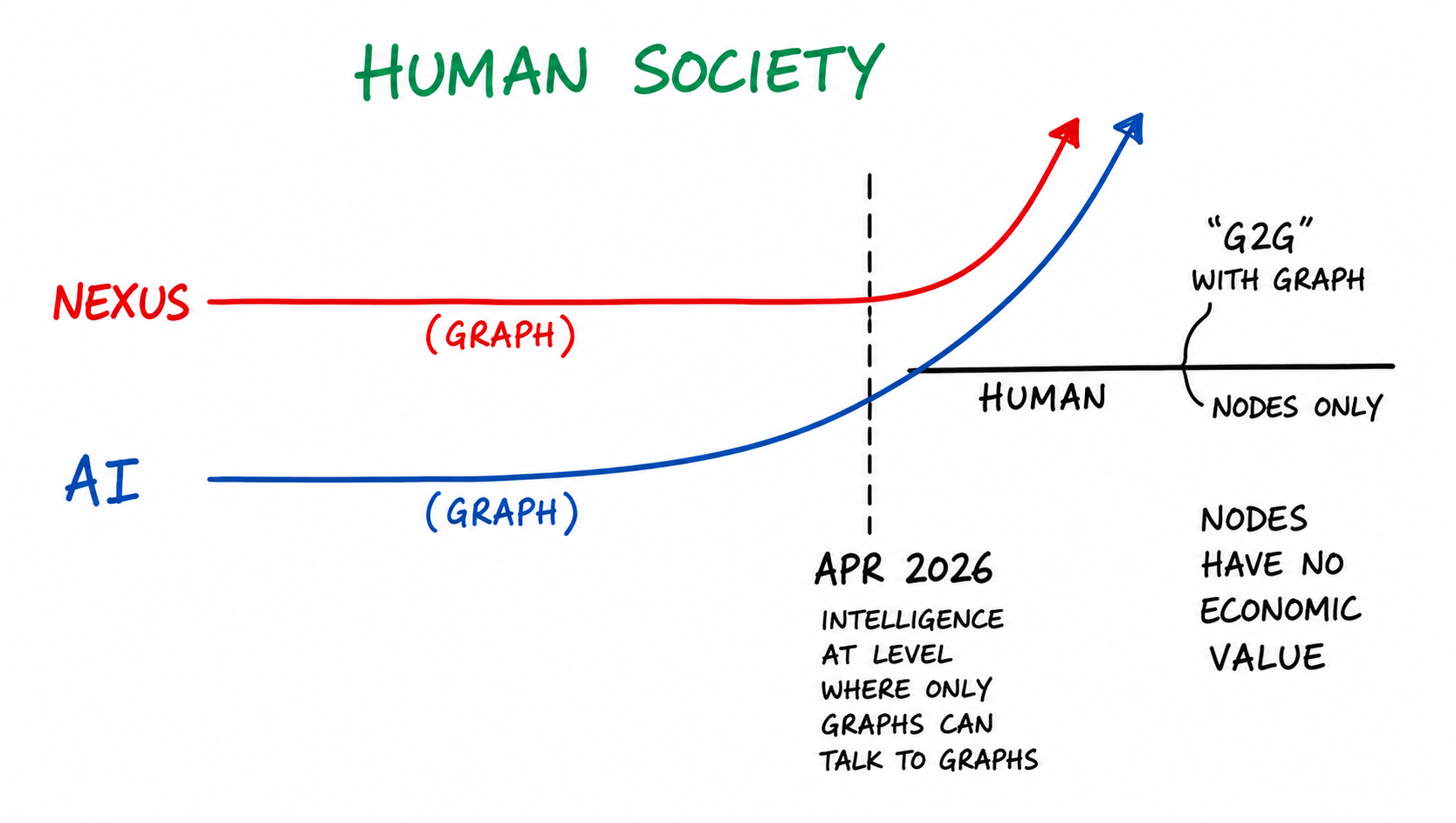
The diagram describes two trajectories:
- Human Society (red)
- AI (blue)
Both are represented as “graphs.”
The key insight is that:
- Human capability grows relatively linearly.
- AI capability grows exponentially through graph connectivity.
At some point, the AI graph crosses a threshold where:
Graphs primarily talk to graphs.
This marks a structural change in civilisation.
The human is no longer the central routing layer of intelligence.
2. Nodes vs Graphs
Node
A node is an isolated intelligence unit.
Traditionally:
- a person,
- worker,
- expert,
- manager,
- consultant,
- teacher,
- or operator.
Industrial society economically values nodes because:
- communication is expensive,
- coordination is expensive,
- memory is fragmented,
- and trust is slow.
Thus humans become the bridges between information.
Graph
A graph is:
- interconnected intelligence,
- memory,
- coordination,
- process,
- reasoning,
- and trust operating as a unified network.
Graphs possess:
- shared memory,
- recursive learning,
- instant communication,
- distributed cognition,
- automated verification,
- and compounding coordination effects.
Modern AI systems are rapidly evolving from:
- isolated models, toward:
- continuously connected intelligence graphs.
3. Why Graphs Become Exponential
A single human intelligence scales slowly.
But graph intelligence scales through connections.
The value of a graph is not merely:
- the intelligence of the nodes, but:
- the number and quality of relationships between nodes.
This creates exponential effects.
Metcalfe-like dynamics emerge:
- more agents,
- more memory,
- more tools,
- more context,
- more recursive optimisation.
The graph begins improving itself.
4. The Human Bottleneck
Historically humans acted as:
- routers,
- translators,
- coordinators,
- administrators,
- validators,
- and trust intermediaries.
AI systems increasingly absorb these functions.
Examples:
- AI agents coordinating APIs
- autonomous software development
- AI-to-AI negotiation
- machine-generated interfaces
- synthetic research
- automated legal drafting
- autonomous financial operations
At sufficient capability:
Human involvement becomes latency.
Not because humans are unintelligent — but because biological cognition cannot compete with network-speed graph coordination.
5. The “Graphs Talking to Graphs” Threshold
The whiteboard note states:
“Intelligence at level where only graphs can talk to graphs.”
This is the crucial transition.
It means:
- the complexity,
- speed,
- and dimensionality of interaction exceeds unaided human cognitive bandwidth.
Humans can still participate — but only through graph augmentation.
Analogy: Financial Markets
Humans once traded directly.
Then:
- algorithms emerged,
- then high-frequency trading,
- then machine-dominated liquidity.
Humans still exist in markets, but most meaningful interactions occur between machine systems.
The same pattern may occur across:
- law,
- medicine,
- engineering,
- governance,
- logistics,
- research,
- and education.
6. The Declining Economic Value of Isolated Nodes
The diagram notes:
“Nodes have no economic value.”
This statement is intentionally provocative.
It does not mean humans become worthless.
It means:
Isolated cognition loses competitive economic advantage.
Economic value shifts toward:
- participation in graphs,
- network leverage,
- trusted coordination,
- access to intelligence systems,
- and ability to orchestrate graph behaviour.
A single unaided human cannot compete with:
- millions of coordinated AI agents,
- operating continuously,
- across global memory systems.
7. The Human with Graph
The diagram also references:
“G2G with graph.”
This implies:
- Human + Graph becomes the surviving economic unit.
Not:
- Human alone.
The future high-value participant is likely:
- a human integrated with trusted intelligence systems,
- identity systems,
- memory systems,
- and coordination networks.
The individual becomes:
- conductor,
- governor,
- curator,
- value-aligner,
- or meaning-generator, rather than raw processor.
8. April 2026 as Symbolic Threshold
The date “APR 2026” likely represents a conceptual crossing point.
Not necessarily:
- AGI,
- singularity,
- or machine consciousness.
Instead it marks:
- the beginning of economically dominant graph intelligence.
This could correspond to:
- autonomous AI agent ecosystems,
- graph-native businesses,
- recursive software generation,
- AI-run infrastructure,
- AI-to-AI commerce,
- or intelligence networks becoming primary producers of economic value.
The exact date is less important than the transition curve itself.
9. Society After the Threshold
Pre-Threshold Society
Human-centric:
- humans coordinate,
- humans decide,
- humans route information,
- humans create process.
AI acts as:
- tool,
- assistant,
- augmentation layer.
Post-Threshold Society
Graph-centric:
- graphs coordinate,
- graphs negotiate,
- graphs optimise,
- graphs build,
- graphs communicate.
Humans increasingly provide:
- legitimacy,
- meaning,
- ethics,
- culture,
- emotional grounding,
- and governance.
10. The Great Economic Repricing
This transition may create:
- massive abundance, while simultaneously:
- collapsing traditional labour value.
Because intelligence itself becomes abundant.
Historically scarcity created value.
If:
- reasoning,
- coding,
- design,
- analysis,
- legal drafting,
- optimisation, become near-free, then economic systems built on scarcity destabilise.
The result may be:
- post-labour economics,
- universal participation systems,
- reputation economies,
- graph-governance systems,
- or entirely new forms of societal coordination.
11. The Emerging Divide
The future divide may not be:
- rich vs poor, or:
- human vs AI.
Instead:
Connected vs disconnected.
Those integrated into trusted intelligence graphs may gain:
- amplified capability,
- amplified coordination,
- amplified opportunity.
Disconnected individuals may struggle economically even while basic abundance increases.
12. Implications for Institutions
Governments
Need new models for:
- taxation,
- labour,
- welfare,
- identity,
- and governance.
Education
Education shifts from:
- memorisation, toward:
- orchestration,
- judgment,
- ethics,
- systems thinking,
- graph participation.
Business
Firms become:
- intelligence networks, not merely organisations.
The competitive advantage becomes:
- graph quality, not headcount.
Identity & Trust
As graphs communicate autonomously:
- verification,
- provenance,
- identity,
- and trust become foundational infrastructure.
This aligns strongly with:
- SSI,
- KERI,
- ACDC,
- cryptographic trust systems,
- and verifiable coordination architectures.
13. The Human Question
The deepest question is not technological.
It is civilisational.
If machines become the dominant economic intelligence layer:
What is humanity for?
Possible answers include:
- meaning creation,
- exploration,
- stewardship,
- beauty,
- culture,
- relationships,
- care,
- governance,
- spirituality,
- and conscious experience itself.
The transition may force civilisation to redefine human value beyond labour.
14. Conclusion
The whiteboard diagram captures a profound possibility:
- intelligence becomes networked,
- graphs become economically dominant,
- isolated cognition loses leverage,
- and humanity enters a graph-mediated civilisation.
The future may not belong to:
- humans, nor:
- AI alone.
It may belong to:
Human societies capable of forming trusted intelligence graphs.
The key question is no longer:
“Can AI think?”
But rather:
“How do humans remain meaningful participants inside exponentially scaling intelligence graphs?”