
From Zero to One Proof
Podcast
How the First Product Proof Point Changes Everything
Innovation begins in a state of unproven possibility.
There may be a compelling idea, a clear need, a sophisticated architecture, a capable team, and a strong sense of where the future is heading.
But none of these, on their own, constitute proof.
Before the first real product outcome, the innovation remains hypothetical.
It may be plausible.
It may be desirable.
It may even appear inevitable.
But it has not yet crossed into reality.
This is the importance of moving from zero to one proof.
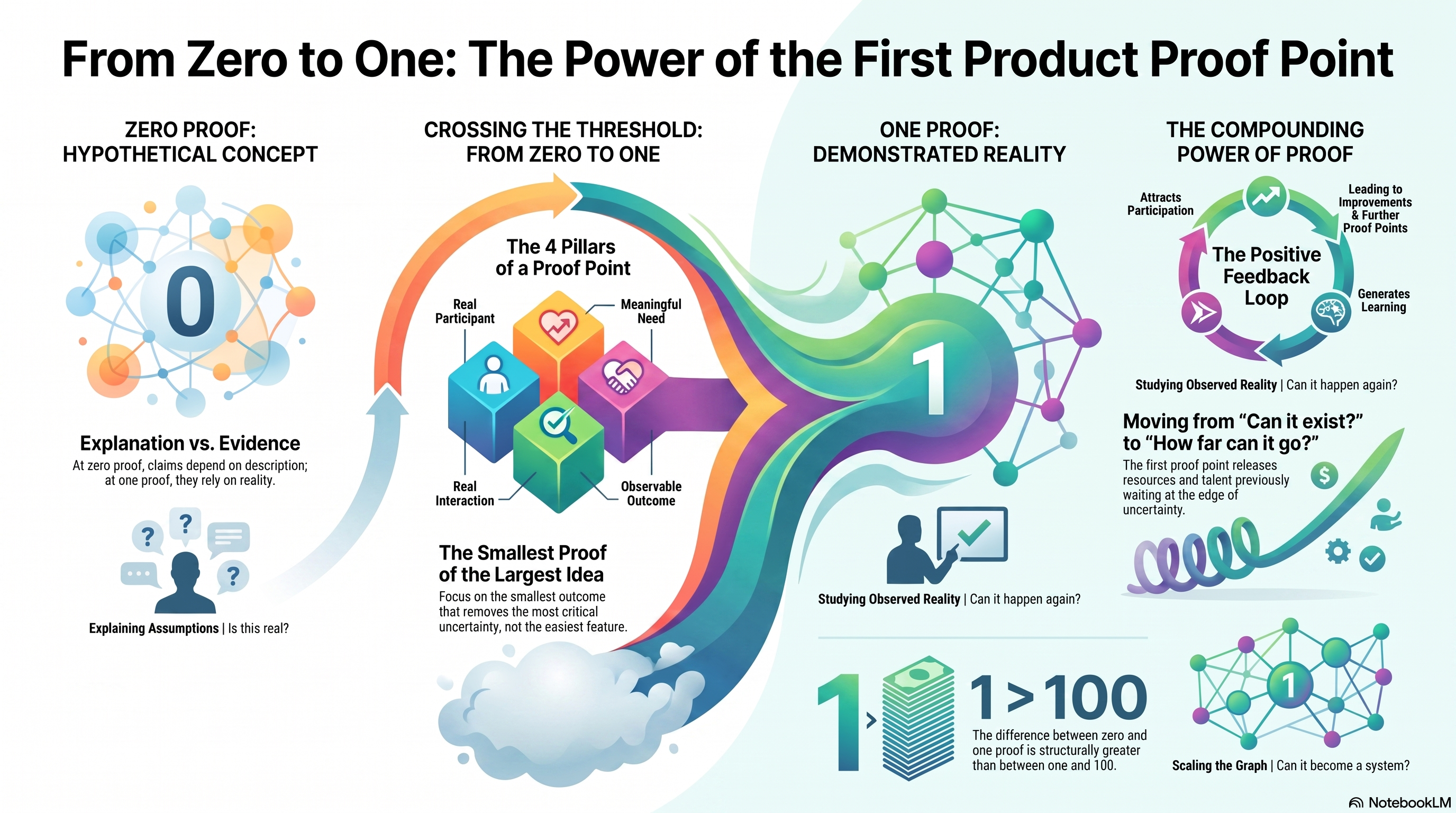
Zero proof means there is no confirmed instance that the proposed product can create meaningful value in the real world.
One proof means that it has happened.
A person used it.
A process changed.
A system worked.
A decision improved.
A problem was reduced.
A meaningful outcome occurred.
The movement from zero to one proof is not simply the addition of one more piece of evidence.
It is a change in state.
Before it, the product is something that might work.
After it, the product is something that has worked.
That distinction changes everything.
Zero Is Not Merely Less Than One
Zero and one are numerically close.
In innovation, they are structurally different.
At zero proof, every claim depends on explanation.
The innovator must describe:
- what the product will do,
- why people will use it,
- how the technology will operate,
- what value it will create,
- why organisations will adopt it,
- how it may scale,
- and why others should believe.
The more novel the idea, the greater the explanatory burden.
People must mentally simulate a future they have never seen.
They must accept assumptions about technology, behaviour, trust, economics, operations, and timing.
At one proof, the conversation changes.
The innovator can point to something concrete.
This worked here. This person received value. This organisation changed its behaviour. This outcome was produced.
The proof does not eliminate every remaining uncertainty.
It establishes that the boundary between imagination and reality can be crossed.
That is why the first proof point is disproportionately valuable.
The difference between zero and one proof is often greater than the difference between one and one hundred.
What Counts as a Product Proof Point?
A product proof point is not simply evidence that something was built.
A prototype may prove technical capability.
A demonstration may prove that a designed sequence can be performed.
A presentation may prove that an idea can be communicated.
A product proof point demonstrates that a real product creates a meaningful outcome under real conditions.
It normally includes four elements:
-
A real participant
Someone outside the immediate design process engages with the product.
-
A meaningful need
The product addresses something the participant genuinely cares about.
-
A real interaction
The product is used, not merely observed or described.
-
An observable outcome
Something becomes better, easier, faster, safer, clearer, more trusted, or newly possible.
A technically successful demonstration may still fail to become a product proof point if nobody receives meaningful value from it.
Likewise, a small and technically simple interaction may become a powerful proof point if it clearly changes an important outcome.
Proof is not determined by the complexity of the product.
It is determined by the reality of the value created.
The First Proof Point Is a State Transition
Before the first proof point, uncertainty surrounds nearly every dimension of the innovation:
- technical feasibility,
- user behaviour,
- product usefulness,
- organisational acceptance,
- operational viability,
- commercial value,
- trust,
- integration,
- repeatability,
- and scale.
The first proof point does not resolve all of these questions.
Instead, it creates a state transition.
The innovation moves:
- from theoretical to observable,
- from promised to demonstrated,
- from imagined to experienced,
- from explanation to evidence,
- from belief to reference,
- from zero to one.
This shift affects not only how outsiders see the product.
It changes how the team itself understands the work.
Before proof, the team is operating primarily from assumptions.
After proof, it can begin operating from observed reality.
It now has something to study.
Something to improve.
Something to repeat.
Something to compare against.
Something around which further learning can accumulate.
One Proof Point Creates the Conditions for Another
The first proof point is rarely valuable only as an isolated success.
Its deeper value is that it makes subsequent proof easier.
The first user helps create the second user
The first participant must often act without precedent.
They accept a high level of uncertainty because there is little external evidence available.
The second participant does not face exactly the same decision.
They can observe what happened with the first.
The uncertainty is reduced.
The first proof point therefore lowers the threshold for the next participant.
The first implementation helps create the second implementation
The team no longer begins from a blank page.
It has learned:
- where the product failed,
- which assumptions were incorrect,
- what users found confusing,
- what integrations were difficult,
- what created value,
- and what could be reused.
The second implementation begins with more knowledge and less uncertainty.
The first outcome creates a story
Before proof, the innovation is normally explained through abstractions.
After proof, it can be communicated through an event.
A story can be told about a person, a problem, an interaction, and an outcome.
Stories travel more easily than architectures.
Other people can recognise themselves within them.
The first proof point attracts resources
Talent, capital, partners, customers, and institutional support are generally more willing to move toward demonstrated momentum.
The central question changes from:
Can this exist?
to:
How far can this go?
That shift can release resources that were previously waiting at the edge of uncertainty.
Proof Compounds
Once one proof point exists, it can produce many forms of additional evidence.
A single product interaction may generate:
- a technical proof,
- a usability proof,
- a behavioural proof,
- a value proof,
- a trust proof,
- an operational proof,
- an integration proof,
- a commercial proof,
- and a repeatability proof.
For example, a customer successfully using a new product may prove that the technology functions.
Continued use may prove that the product remains valuable.
Renewal may prove that the value persists over time.
Expansion into another team may prove that the pattern transfers.
A referral may prove that the participant is willing to attach their own reputation to it.
Each proof point strengthens adjacent claims.
Over time, isolated evidence develops into a network of evidence.
This network becomes increasingly difficult to dismiss because the innovation is no longer supported by a single event.
It is supported by multiple connected realities.
Proof Points Form a Graph
Innovation is often described as a linear journey:
idea → prototype → product → adoption → scale
In practice, product proof develops more like a graph.
A technical proof point may lead to an integration proof point.
An integration proof point may create an operational proof point.
An operational proof point may enable a trust proof point.
A trust proof point may attract a new participant.
That participant may reveal an entirely new use case.
The proof graph expands as each verified outcome opens new connections.
Some nodes in the graph represent products.
Others represent people, organisations, behaviours, processes, technologies, and outcomes.
The more strongly these nodes connect, the more resilient the proof becomes.
If one proof point is challenged, the larger graph can still hold.
This is how an emerging product gradually becomes credible infrastructure.
It is supported not by one claim, but by a connected field of evidence.
The First Proof Point Is a Trust Anchor
Novel products require people to operate beyond what is already familiar.
They must accept some combination of technical, financial, organisational, behavioural, and reputational risk.
People rarely assess all of these risks from first principles.
They search for anchors.
They ask:
- Has anyone used this?
- Did it work?
- Was the outcome meaningful?
- Who trusts it?
- Can I see something real?
- Can I speak to someone who experienced it?
- Is the result repeatable?
The first proof point gives confidence somewhere to attach.
It does not prove that every future claim is correct.
It provides a credible place from which belief can begin.
This is especially important for large visions.
The larger and more transformative the vision, the harder it is to hold entirely in abstraction.
A small but meaningful proof point gives the larger vision weight.
It demonstrates that the future is not only conceptually coherent.
It has already begun to appear.
The Smallest Proof of the Largest Idea
A common mistake is to make the first product attempt too broad.
The innovator tries to prove the complete vision in one implementation.
This creates unnecessary complexity.
More features are included.
More participants are involved.
More integrations are required.
More assumptions must hold simultaneously.
The result is that the first proof point becomes harder to achieve and harder to interpret.
A better approach is to identify:
What is the smallest meaningful outcome that proves the most important part of the idea?
The first product should not attempt to contain the whole future.
It should contain the essential pattern of the future.
A strong first proof point is:
- narrow enough to be achievable,
- meaningful enough to matter,
- real enough to be trusted,
- clear enough to be understood,
- measurable enough to be evaluated,
- and connected enough to open the next step.
The goal is not to prove everything.
It is to prove the central thing from which more can follow.
Choosing the Right Uncertainty to Remove
Not all proof points are equally valuable.
A proof point should be selected according to the uncertainty that most prevents progress.
For one innovation, the greatest uncertainty may be technical.
Can the system perform the required operation?
For another, it may be behavioural.
Will people change how they act?
For another, it may be organisational.
Can the product work inside existing structures and constraints?
For another, it may be trust.
Will participants rely on the outcome?
The first proof point should target the uncertainty that most blocks movement.
This leads to a more useful question than:
What is the easiest feature to build?
The better question is:
What is the smallest real outcome that removes the most important uncertainty?
When that uncertainty is removed, many other decisions become easier.
The Inverse: Remaining at Zero Proof
The logic of proof also operates in reverse.
When an innovation continues making claims without creating a real proof point, the absence of proof gradually becomes meaningful.
At first, a lack of proof is expected.
Every innovation begins at zero.
But over time, continued explanation without evidence can create doubt.
The vision becomes larger.
The architecture becomes more sophisticated.
The proposed applications multiply.
More features are promised.
More markets are described.
Yet nothing becomes concrete.
Eventually, people begin to infer explanations for the absence of proof:
- perhaps the product cannot be built,
- perhaps the problem is not important,
- perhaps users do not understand it,
- perhaps the value exists only in theory,
- perhaps the system is too complex,
- perhaps the team is avoiding real-world testing,
- perhaps the innovation depends on perpetual belief.
Zero proof is initially neutral.
Prolonged zero proof is not.
Over time, the absence of evidence can become evidence about the innovation itself.
Claims Also Compound in Reverse
Before proof, every additional claim increases the amount that must eventually be demonstrated.
A broad vision can create excitement.
But if claims continue expanding while evidence remains at zero, the distance between the two becomes increasingly visible.
This creates an inverse compounding effect:
- more claims create more expectations,
- more expectations create more scrutiny,
- greater scrutiny exposes the absence of proof,
- the absence of proof creates doubt,
- doubt makes participants less willing to engage,
- reduced engagement creates fewer opportunities to generate proof.
The innovation can become trapped.
It needs participation to create evidence.
But it needs evidence to attract participation.
This is why the first proof point often requires deliberate focus, direct support, and a carefully selected early participant.
The zero-to-one crossing may not happen naturally.
It must often be intentionally designed.
The Inverse: From One Failure to Many Doubts
A negative proof point can also compound.
This is particularly dangerous when the product has very little other evidence.
In a mature system, one failure is interpreted within a large body of successful outcomes.
In a new system, one failure may represent almost everything people know.
A failed deployment can quickly become interpreted as:
- the technology is unreliable,
- the idea is too difficult,
- users will not adopt it,
- the organisation cannot deliver,
- the product does not solve a real problem,
- the larger vision is unrealistic.
The failure itself may be narrow.
Its interpreted meaning may become broad.
This can create a negative proof graph:
- one failure generates doubt,
- doubt reduces participation,
- reduced participation limits learning,
- limited learning delays improvement,
- delayed improvement creates further failure,
- further failure reinforces the original conclusion.
The inverse compounding effect can become as powerful as positive proof.
This does not mean innovators should avoid failure.
Failure is essential to learning.
It means early failures must be bounded, interpreted correctly, and converted into visible improvement.
Proof Is Not Perfection
The need for proof can easily be confused with the need for polish.
They are not the same.
A first product proof point does not require:
- a complete platform,
- a perfect interface,
- automated operations,
- large-scale adoption,
- every planned feature,
- or a final business model.
It requires a meaningful outcome.
An imperfect product that creates real value contains more useful proof than a polished product that nobody meaningfully uses.
The first proof point should be evaluated by the change it creates, not by how closely it resembles the final vision.
This allows innovators to move earlier into reality.
It replaces the pursuit of abstract completeness with the pursuit of verified value.
Protecting the First Proof
Because the first proof point carries disproportionate meaning, it should be designed carefully.
This does not mean manipulating the result or avoiding genuine testing.
It means creating conditions in which the central idea can be tested clearly.
The team should carefully choose:
- the first use case,
- the first participant,
- the first environment,
- the first measure of success,
- the boundaries of the claim,
- and the next proof point that success will enable.
The first product should not be burdened with every possible use case.
The first participant should have a real need and enough commitment to engage properly.
The success measure should be observable.
The claim should be narrow enough that the result can be interpreted honestly.
A clear proof point is more valuable than a broad but ambiguous success.
From Product Proof to Proof System
The first proof point is not the destination.
It is the beginning of a system that continuously produces evidence.
Each implementation should strengthen the capacity to produce the next by generating:
- reusable product components,
- operational knowledge,
- stronger relationships,
- clearer measures,
- improved language,
- reduced risk,
- and greater trust.
The product then begins to create its own conditions for growth.
Proof attracts participation.
Participation creates use.
Use generates learning.
Learning improves the product.
Improvement creates stronger outcomes.
Stronger outcomes create more proof.
This is the positive compounding loop.
The innovation no longer depends entirely on the force of its original vision.
It develops momentum through verified reality.
From Zero to One Changes the Question
At zero proof, the dominant question is:
Is this real?
At one proof, the question becomes:
Can it happen again?
With repeated proof:
Can it work elsewhere?
With connected proof:
Can it become a system?
With sustained proof:
Can it become infrastructure?
Each stage depends on the one before it.
The largest systems begin with one meaningful crossing into reality.
They begin when one person, team, organisation, or community experiences an outcome that did not previously exist.
That outcome becomes a reference.
The reference becomes a pattern.
The pattern becomes a graph.
The graph becomes a system.
Conclusion
Innovation does not become real merely because it is well imagined.
It becomes real when it produces its first meaningful outcome.
That is the movement from zero to one proof.
The first product proof point changes the state of the innovation.
It replaces pure possibility with evidence.
It gives trust somewhere to attach.
It reduces the risk of the next participant.
It gives the team something real to improve and repeat.
It allows one proof point to create another.
Over time, proof compounds into a connected graph of technical, human, operational, commercial, and social evidence.
The inverse is equally important.
Remaining at zero proof for too long can cause claims to compound into doubt.
One poorly contained failure can become many negative interpretations.
Reduced trust can lead to reduced participation, reduced learning, and further failure.
The earliest task of innovation is therefore not to prove the whole future.
It is to identify and create the smallest meaningful outcome that demonstrates the future is possible.
The first proof point does not need to show that the innovation is complete.
It only needs to establish that it is real.
From there, one proof can become many.