
selfdriven institute / Resources
The Eight-Whiteboard Organisational Framework
A Weekly Relevance Rhythm for the Generative AI Era
Podcast
1. Framework Purpose
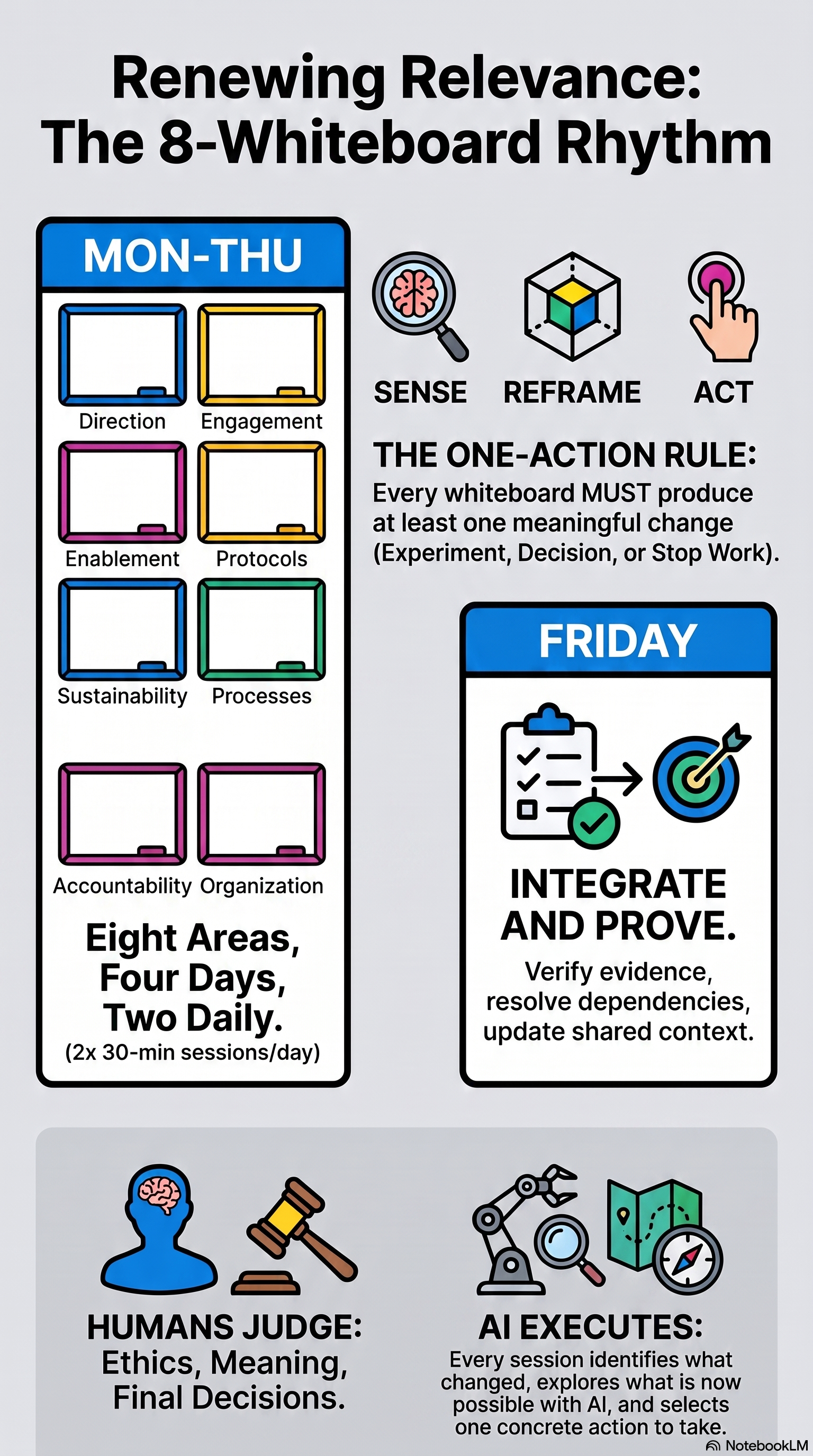
The Eight-Whiteboard Organisational Framework helps an organisation continuously reconsider itself across its eight Areas of Focus:
- Direction
- Engagement
- Enablement
- Protocols
- Sustainability
- Processes
- Accountability
- Organisational
Each area receives one dedicated whiteboard session every week.
The organisation conducts two sessions per day over four days, creating a repeatable weekly rhythm:
Eight Areas of Focus. Eight whiteboards. Two each day. Every week.
The fifth day is used to consolidate learning, complete experiments, verify proof points and update organisational direction.
The framework prevents Generative AI from being treated as a separate technology initiative. Instead, the implications of AI are considered across every part of the organisation.
2. The Weekly Rhythm
Monday
Morning: Direction
What now matters?
Afternoon: Engagement
Who do we need to understand, involve or serve differently?
Tuesday
Morning: Enablement
What new capability do people and agents need?
Afternoon: Protocols
What rules, standards and trust mechanisms need to change?
Wednesday
Morning: Sustainability
What will keep this valuable and viable?
Afternoon: Processes
How should the work now operate?
Thursday
Morning: Accountability
How will we know, verify and take responsibility?
Afternoon: Organisational
How should roles, decisions and coordination change?
Friday: Integration and Proof
Friday does not require another whiteboard.
It is used to:
- complete the week’s experiments,
- verify evidence,
- resolve cross-area dependencies,
- update shared organisational context,
- communicate decisions,
- retire obsolete work,
- and prepare the opening context for the following week.
The rhythm becomes:
Explore across eight areas from Monday to Thursday. Integrate, prove and embed on Friday.
3. The Common Whiteboard Method
Every Area of Focus uses the same three movements.
Sense
What has changed?
The team identifies:
- new information,
- emerging risks,
- changing needs,
- AI capabilities,
- operating signals,
- failed assumptions,
- and new opportunities.
Reframe
What is now possible?
The team considers:
- what can be removed,
- what can be simplified,
- what can be redesigned,
- what AI can assist,
- what should remain human-led,
- and what would be designed differently if starting today.
Act
What will we change now?
The team selects:
- a decision,
- an experiment,
- a proof point,
- a changed priority,
- a process adjustment,
- or something to stop.
Each session therefore follows the same pattern:
Sense → Reframe → Act
The organisation does not need three separate sessions for these movements. They occur within each focused whiteboard.
4. Whiteboard One: Direction
Core Question
What now matters?
Purpose
The Direction Whiteboard keeps organisational purpose, priorities and action aligned with current reality.
It examines whether the organisation is still directing its intelligence, resources and attention toward the outcomes that matter most.
Sense
Ask:
- What has changed in our strategic context?
- What new customer, community or market needs are emerging?
- Which assumptions behind our current direction have weakened?
- What new AI capabilities may affect our direction?
- Are current priorities still connected to purpose?
- What are we doing simply because it was previously planned?
Reframe
Ask:
- Would we choose the same priorities today?
- What could now be achieved differently?
- Does AI change what is strategically possible?
- What can be accelerated, paused or stopped?
- Where should human attention be concentrated?
- What is the most important organisational proof point?
Act
Possible outputs include:
- changed priorities,
- revised strategic assumptions,
- work to pause or stop,
- a new strategic experiment,
- a changed allocation of attention,
- or an updated statement of what matters this week.
Primary Output
A current organisational direction:
Given what we now know, this is what matters most.
5. Whiteboard Two: Engagement
Core Question
Who do we need to understand, involve or serve differently?
Purpose
The Engagement Whiteboard considers the organisation’s relationships with:
- customers,
- communities,
- partners,
- suppliers,
- regulators,
- investors,
- participants,
- and other stakeholders.
It ensures that AI-enabled change remains connected to real people and trusted relationships.
Sense
Ask:
- What are people telling us?
- Where are people experiencing friction?
- Which expectations are changing?
- Who is not being heard?
- Has AI changed how people expect to interact with us?
- Where is trust increasing or declining?
- Which relationships now require more attention?
Reframe
Ask:
- Can participation become easier?
- Can communication become conversational?
- Can services become more personalised?
- Can people act more directly?
- Can AI improve accessibility without weakening human connection?
- Are we designing with people or merely for them?
- What relationship could be strengthened through one small proof?
Act
Possible outputs include:
- a stakeholder conversation,
- a new engagement experiment,
- a changed service interaction,
- a community feedback loop,
- a revised communication approach,
- or a partnership action.
Primary Output
A more current understanding of who matters and how the organisation should relate to them.
6. Whiteboard Three: Enablement
Core Question
What new capability do people and agents need?
Purpose
The Enablement Whiteboard ensures that people, teams and AI agents have the capability, context and tools required to contribute effectively.
Enablement includes:
- knowledge,
- skills,
- confidence,
- tools,
- access,
- context,
- support,
- and authority.
Sense
Ask:
- Where are people being blocked?
- What capability is currently scarce?
- What knowledge is concentrated in too few people?
- Where is AI already changing how work is performed?
- What are people doing manually because they lack suitable tools?
- Where do people need greater AI literacy?
- Which agents lack the context required to act well?
Reframe
Ask:
- Can specialist knowledge become more widely available?
- Can an agent support the first stage of the work?
- Can training happen inside the workflow?
- Can people be given greater decision authority?
- Can context be provided at the moment it is needed?
- What capability would unlock several other improvements?
- What should humans become better at as AI handles more volume?
Act
Possible outputs include:
- a learning activity,
- a new tool,
- improved agent instructions,
- access to organisational context,
- a capability experiment,
- delegated authority,
- or a new support mechanism.
Primary Output
One practical improvement to organisational capability.
7. Whiteboard Four: Protocols
Core Question
What rules, standards and trust mechanisms need to change?
Purpose
The Protocols Whiteboard examines the formal and informal rules through which the organisation coordinates trusted activity.
Protocols may include:
- identity,
- authentication,
- authorisation,
- permissions,
- credentials,
- data exchange,
- interfaces,
- standards,
- decision rules,
- agent constraints,
- and escalation conditions.
Sense
Ask:
- Which protocols are creating unnecessary friction?
- Which rules assume intelligence is scarce or centralised?
- Where are permissions unclear?
- What information is difficult to exchange?
- Which trust assumptions are no longer valid?
- Where could AI act without sufficient boundaries?
- Which protocols exist only because systems cannot currently communicate?
Reframe
Ask:
- Can the protocol become simpler?
- Can authority be delegated safely?
- Can trust be made verifiable?
- Can systems exchange structured context directly?
- Can permissions be made explicit and machine-readable?
- What must always require human approval?
- Which rule could be replaced with a clearer decision boundary?
Act
Possible outputs include:
- a revised protocol,
- a new decision rule,
- an updated agent constraint,
- a changed permission,
- an integration experiment,
- a verification requirement,
- or removal of an unnecessary approval step.
Primary Output
A clearer and more trusted way for people, systems and agents to coordinate.
8. Whiteboard Five: Sustainability
Core Question
What will keep this valuable and viable?
Purpose
The Sustainability Whiteboard considers whether organisational activity can continue to create value over time.
It includes:
- financial viability,
- resource use,
- resilience,
- workforce capacity,
- environmental impact,
- operational continuity,
- and long-term community value.
Sense
Ask:
- Which activities are becoming too expensive?
- Where are resources being consumed without sufficient value?
- What dependency creates fragility?
- Is AI changing the economics of the work?
- What capability needs continued investment?
- Where are people becoming overloaded?
- What is currently viable only because its full cost is hidden?
Reframe
Ask:
- Can the cost structure be redesigned?
- Can repetitive effort be removed?
- Can a new capability serve multiple areas?
- Can resources be shared?
- Can revenue or value be created differently?
- Can resilience be increased through distributed capability?
- What should be sustained, and what should be allowed to end?
Act
Possible outputs include:
- a resource reallocation,
- a cost-removal experiment,
- a new value model,
- a resilience action,
- retirement of unsustainable work,
- or investment in a shared capability.
Primary Output
A concrete action that improves long-term viability or resilience.
9. Whiteboard Six: Processes
Core Question
How should the work now operate?
Purpose
The Processes Whiteboard examines how value moves through the organisation.
It challenges teams to redesign work rather than simply automate existing steps.
Sense
Ask:
- Where is work slowing down?
- Which activities are duplicated?
- Where does information repeatedly change hands?
- Which steps add no meaningful judgement?
- What process failures occurred this week?
- Where are people working around the official process?
- Which tasks can now be assisted or performed by AI?
Reframe
Ask:
- Can the process be removed?
- Can several steps become one?
- Can the experience become conversational?
- Can decisions move closer to the point of information?
- Can an agent coordinate the workflow?
- What must remain under human control?
- Would this process exist in its current form if designed today?
Act
Possible outputs include:
- removal of a process step,
- a workflow experiment,
- a new agent-assisted process,
- changed decision placement,
- a prototype,
- a revised instruction,
- or retirement of a report or meeting.
Primary Output
A smaller, clearer or more effective way of working.
10. Whiteboard Seven: Accountability
Core Question
How will we know, verify and take responsibility?
Purpose
The Accountability Whiteboard ensures that actions and AI-enabled decisions remain visible, explainable and connected to responsible people.
Accountability includes:
- evidence,
- measures,
- logs,
- auditability,
- review,
- risk ownership,
- quality,
- and decision responsibility.
Sense
Ask:
- What are we unable to verify?
- Which decisions lack clear ownership?
- Are current measures still meaningful?
- Where is AI producing outputs without adequate checking?
- What evidence is being lost?
- Which risks have no active owner?
- Are we measuring activity rather than value?
Reframe
Ask:
- What evidence would genuinely demonstrate value?
- Can decisions be linked to their context and assumptions?
- Can accountability be built into the workflow?
- Which AI outputs need domain verification?
- Can measures be simplified?
- What should be logged?
- Who must remain responsible even when an agent performs the work?
Act
Possible outputs include:
- a proof-point definition,
- a new quality check,
- an assigned risk owner,
- a revised measure,
- improved logging,
- a decision record,
- or a human verification requirement.
Primary Output
Clear ownership supported by sufficient evidence.
11. Whiteboard Eight: Organisational
Core Question
How should roles, decisions and coordination change?
Purpose
The Organisational Whiteboard considers how the organisation itself should be arranged in response to new capabilities and changing conditions.
It examines:
- roles,
- teams,
- authority,
- coordination,
- decision rights,
- culture,
- agent participation,
- and organisational boundaries.
Sense
Ask:
- Where are decisions occurring too far from the work?
- Which roles are changing because of AI?
- Where is responsibility unclear?
- Which teams depend excessively on another team?
- Where are organisational boundaries blocking value?
- What work is falling between roles?
- Where are people waiting for permission unnecessarily?
Reframe
Ask:
- Can authority move closer to the context?
- Should a role become a shared capability?
- Can an agent coordinate activity across teams?
- What work should shift from execution to judgement?
- What new human responsibilities are emerging?
- Can teams become more self-directed?
- What organisational structure would we create if starting today?
Act
Possible outputs include:
- changed decision rights,
- revised role boundaries,
- a new coordination mechanism,
- creation of a cross-functional team,
- delegation of authority,
- changed human-agent responsibilities,
- or removal of an organisational bottleneck.
Primary Output
A clearer arrangement of people, agents, roles and decisions.
12. Session Structure
Each whiteboard session should take approximately 20 to 30 minutes.
Opening Context — 5 Minutes
The Context Steward presents:
- relevant signals,
- outstanding actions,
- previous assumptions,
- current evidence,
- and changes since the last session.
Sense — 5 Minutes
The group identifies what has materially changed within the Area of Focus.
Reframe — 10 Minutes
The group explores what could now be done differently.
Act — 5 Minutes
The group selects:
- one decision,
- one experiment,
- one proof point,
- or one item of work to stop.
Close — 5 Minutes
Record:
- owner,
- intended outcome,
- evidence required,
- risks,
- dependencies,
- and review date.
13. The One-Action Rule
Every whiteboard should produce at least one meaningful organisational action.
That action does not need to be large.
It may be:
- test something,
- stop something,
- change something,
- verify something,
- ask someone,
- redesign something,
- or make a decision.
The objective is not eight large initiatives every week.
The objective is eight deliberate opportunities for organisational learning and renewal.
A valid output may also be:
We reviewed this area, found the current approach remains appropriate, and recorded the evidence supporting that conclusion.
The whiteboards should create movement where movement is needed, not change for its own sake.
14. Friday Integration
Core Question
What did the eight whiteboards collectively teach us?
Friday brings the eight Areas of Focus back together.
The organisation reviews:
- decisions made,
- experiments started,
- evidence gathered,
- assumptions changed,
- work stopped,
- cross-area dependencies,
- unresolved risks,
- and proof points created.
Integration Questions
- Does a change in one area require changes elsewhere?
- Are any actions in conflict?
- What common pattern appeared across several whiteboards?
- Which experiment should receive more support?
- What organisational learning should be shared?
- What should become part of normal operations?
- What needs formal governance?
- What context must carry into next week?
Friday Outputs
- weekly organisational learning summary,
- verified proof points,
- updated context,
- cross-area actions,
- decisions to scale, change or stop,
- and the following week’s opening questions.
15. Weekly Operating Board
A single weekly board can show all eight areas.
| Area | What Changed? | What Is Now Possible? | What Will Change? | Owner | Evidence | Status |
|---|---|---|---|---|---|---|
| Direction | ||||||
| Engagement | ||||||
| Enablement | ||||||
| Protocols | ||||||
| Sustainability | ||||||
| Processes | ||||||
| Accountability | ||||||
| Organisational |
This creates a visible map of how the organisation is learning and changing each week.
16. Participation Model
Not everyone needs to attend every whiteboard.
Each session should include:
- an Area Conductor,
- the Context Steward,
- people closest to the relevant work,
- an appropriate Decision Owner,
- and a Domain Verifier where required.
Participants may change between areas.
For example:
- Direction may involve leadership and strategic contributors.
- Engagement may involve customers, community or partnership teams.
- Enablement may involve people, learning and technology teams.
- Protocols may involve technical, security and governance specialists.
- Sustainability may involve finance, operations and resilience roles.
- Processes may involve the people performing the work.
- Accountability may involve risk, quality and evidence owners.
- Organisational may involve leadership and affected teams.
The framework distributes organisational thinking rather than concentrating all eight sessions within one executive group.
17. AI’s Role in the Framework
AI can support each whiteboard by:
- summarising relevant context,
- identifying patterns,
- comparing previous decisions,
- challenging assumptions,
- generating alternative approaches,
- modelling scenarios,
- producing prototypes,
- identifying dependencies,
- preparing experiments,
- and recording learning.
AI should not independently determine organisational purpose, values or acceptable risk.
Human conduct remains responsible for:
- meaning,
- judgement,
- ethics,
- priorities,
- accountability,
- and final decisions.
The operating relationship is:
Humans conduct direction and judgement. AI expands sensing, exploration and execution.
18. Framework Measures
The framework should be assessed through organisational outcomes rather than meeting volume.
Useful measures include:
Context Currency
How quickly does meaningful new information enter a relevant whiteboard?
Decision Latency
How quickly does evidence result in an appropriate decision?
Learning Velocity
How quickly does the organisation move from question to proof?
Work Removal
How much obsolete, duplicated or low-value work is stopped?
Proof Production
How many useful proof points are created and verified?
Cross-Area Coherence
How effectively are changes coordinated across the eight Areas of Focus?
Relevance
Is the organisation creating more value for the people and communities it serves?
19. Framework Summary
The Eight-Whiteboard Organisational Framework creates a weekly cycle of organisational reconsideration.
Monday
- Direction
- Engagement
Tuesday
- Enablement
- Protocols
Wednesday
- Sustainability
- Processes
Thursday
- Accountability
- Organisational
Friday
- integration,
- proof,
- implementation,
- organisational learning,
- and preparation for the following cycle.
Each whiteboard asks:
What has changed?
What is now possible?
What will we change now?
The result is not constant disruption.
It is continuous organisational attention.
Every week, every Area of Focus is given a structured opportunity to sense change, reconsider assumptions and create evidence-based movement.
The organisation remains coherent because all eight areas share one purpose and one rhythm.
It remains adaptive because no area is allowed to operate indefinitely from stale assumptions.
In the Generative AI era, organisational relevance is not reviewed annually.
It is renewed eight times a week.