
The Language of Conducting
How Musical Notation Becomes an Executable Language for Coordinating Human and Artificial Intelligence
Companion Paper to Conducting Scores
As organisations transition from managing people to coordinating networks of humans and artificial intelligence, traditional forms of instruction are becoming inadequate. Checklists, procedures, prompts, workflows and playbooks each describe fragments of organisational behaviour, but none provide a complete language for expressing coordinated intelligence.
This paper introduces The Language of Conducting—a domain-specific language inspired by orchestral notation. Rather than treating AI interactions as isolated prompts, this language describes the coordinated performance of agents, contributing to a larger organisational outcome.
Borrowing centuries of refinement from orchestral performance, the language separates strategic intent from operational execution, allowing Conducting Scores to become executable specifications for intelligent organisations.
Podcast
From Prompt Engineering to Conducting
Current AI systems are largely built around prompts.
A prompt tells a model what to do at a particular moment.
Organisations, however, do not operate through isolated moments.
They operate through continual coordination.
An orchestra demonstrates a more mature model.
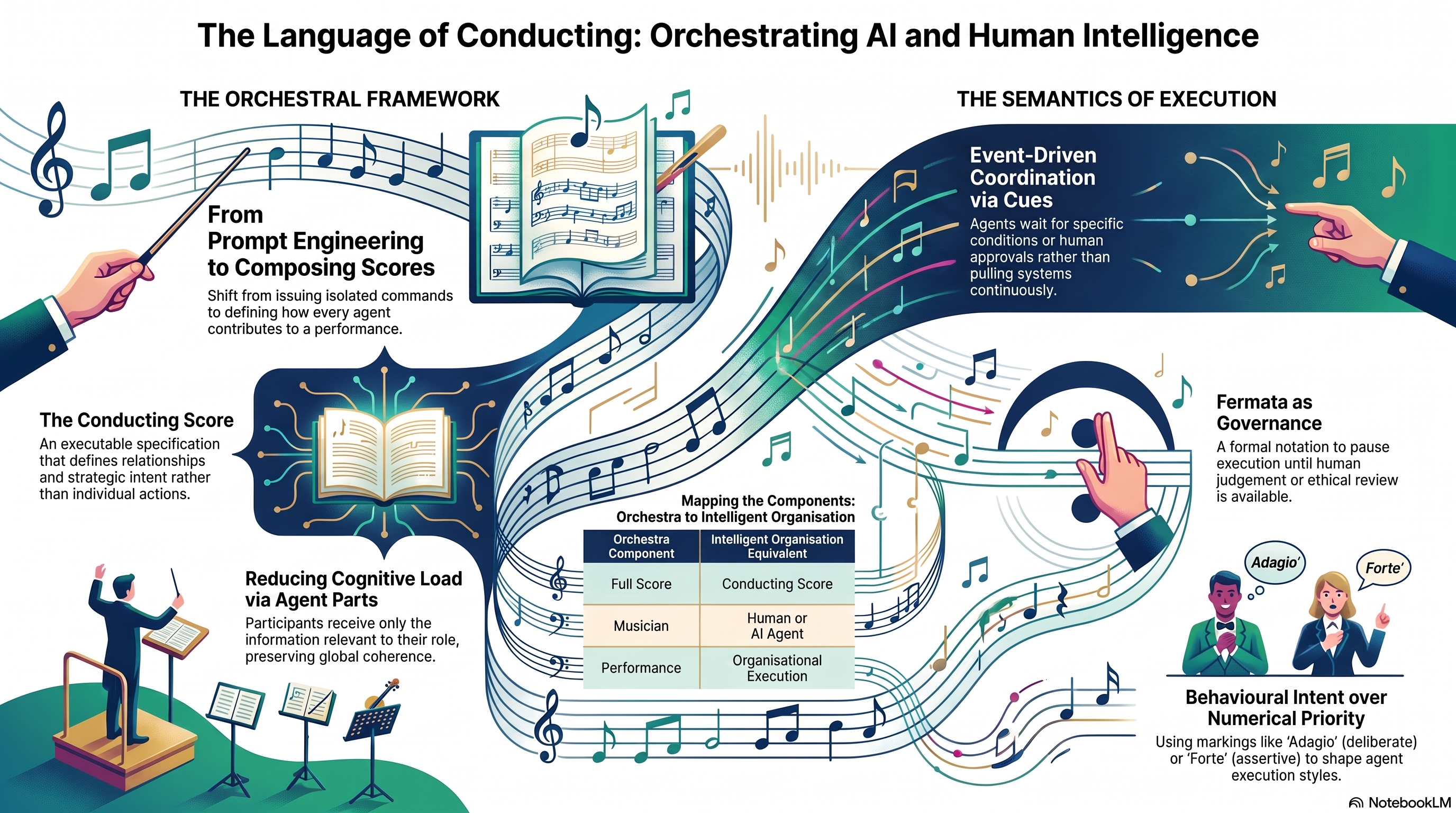
The composer does not write instructions for individual musicians independently. Instead, a complete score defines how every instrument contributes to a coherent performance over time.
This distinction suggests an important evolution.
Instead of engineering prompts, we compose Conducting Scores.
Instead of issuing commands, we coordinate performance.
The Orchestra as a Model for Intelligence
An orchestra contains multiple layers of information.
| Orchestra | Intelligent Organisation |
|---|---|
| Composition | Organisational intent |
| Full Score | Conducting Score |
| Instrument Part | Agent Part |
| Conductor | Coordination Layer |
| Musician | Human or AI Agent |
| Performance | Organisational Execution |
| Audience | Stakeholders |
| Rehearsal | Organisational Learning |
Each layer has a distinct responsibility.
The composition defines purpose.
The score defines coordination.
The parts define local behaviour.
The conductor synchronises execution.
The performance produces value.
Why Music?
Music has solved a coordination problem that organisations are only beginning to encounter.
A modern orchestra may contain over one hundred independent performers.
Each performer:
- possesses different capabilities,
- enters at different times,
- receives different information,
- adapts to changing conditions,
- contributes to a shared outcome without requiring complete knowledge of the entire system.
This is remarkably similar to an AI-native organisation.
The Conducting Language
Rather than inventing a new notation, Conducting Scores borrow concepts that musicians have understood for centuries.
These concepts already encode timing, coordination, emphasis, synchronisation and adaptation.
The challenge is not to copy musical notation literally, but to reinterpret its semantics for intelligent systems.
Core Vocabulary
Composition
The enduring purpose of the organisation.
Equivalent to mission and intent.
Conducting Score
The complete specification describing how coordinated intelligence should perform.
A Conducting Score defines relationships rather than commands.
Agent Part
Each participant receives only the information relevant to its role.
This mirrors orchestral performance, where violinists perform from violin parts rather than reading the conductor’s complete score.
This reduces cognitive load while preserving global coherence.
Performance Concepts
Cue
The condition that begins activity.
Rather than polling continuously, agents wait for cues.
Examples include:
- arrival of verified context,
- completion of another agent,
- approval by a human,
- external events.
Rest
Periods of deliberate inactivity.
Rest is an active design decision rather than an absence of work.
Waiting is often the correct behaviour.
Fermata
Pause execution until human judgement is available.
This becomes the formal notation for governance, ethics and decision escalation.
Repeat
Repeat execution until defined conditions are satisfied.
Unlike traditional loops, repeats are expressed in organisational language rather than programming language.
Coda
Graceful completion of a movement or workflow.
Expressing Behaviour
Music already provides a sophisticated vocabulary for expressing behaviour.
These concepts translate naturally into intelligent systems.
| Musical Marking | Organisational Meaning |
|---|---|
| Piano | Minimise disruption |
| Forte | Execute assertively |
| Crescendo | Increase effort |
| Diminuendo | Reduce effort |
| Allegro | Execute rapidly |
| Adagio | Execute deliberately |
| Largo | Slow reflective execution |
| Prestissimo | Emergency response |
Rather than assigning numerical priorities, Conducting Scores communicate behavioural intent.
Organisational Rhythm
Music is organised into measures.
Organisations also operate rhythmically.
- Daily reviews.
- Weekly planning.
- Quarterly strategy.
- Annual governance.
Conducting Scores formalise these rhythms.
For example:
4/4 might represent:
- Observe
- Plan
- Act
- Reflect
while another organisation may naturally operate within a three-phase rhythm:
- Observe
- Act
- Learn
The rhythm becomes part of organisational identity.
Articulation
Musicians do not merely play notes.
They shape them.
Likewise, intelligent agents should distinguish between different styles of execution.
Examples include:
Legato
Maintain continuity with previous reasoning.
Staccato
Produce concise independent outputs.
Marcato
Emphasise important findings.
Accent
Immediately draw attention to critical information.
Instrumentation
Every agent represents an instrument within the organisational ensemble.
Different instruments possess different strengths.
Research agents detect weak signals.
Compliance agents maintain organisational rhythm.
Facilitators synchronise performance.
Decision agents resolve uncertainty.
Observation agents provide situational awareness.
The language focuses on capability rather than implementation.
Harmony
The objective is not individual optimisation.
The objective is harmony.
Each participant contributes only a partial view.
The Conducting Score aligns these contributions into coherent organisational behaviour.
Harmony therefore becomes an engineering objective rather than merely an artistic one.
Counterpoint
Many organisational activities occur simultaneously.
Counterpoint describes independent lines of activity that remain mutually compatible.
This concept naturally models parallel intelligent systems operating from shared verified context.
From Scores to Signals
Performance produces signals.
Signals modify Verified Context Graphs.
Updated context produces new cues.
New cues initiate further performance.
Learning therefore emerges as a continuous cycle rather than a separate activity.
Conducting Scores do not terminate organisational learning.
They sustain it.
Relationship to Verified Context Graphs
Verified Context Graphs answer the question:
What is true?
Conducting Scores answer the question:
Given what is true, how should coordinated intelligence perform?
The separation is fundamental.
Context remains independently verifiable.
Execution remains independently composable.
This enables organisations to evolve behaviour without compromising the integrity of organisational knowledge.
Conclusion
The Language of Conducting is not a metaphor for artificial intelligence.
It is an executable language for coordinated intelligence.
Where prompt engineering focuses on isolated interactions, Conducting focuses on sustained organisational performance.
A Conducting Score becomes more than documentation.
It becomes the shared language through which humans and machines coordinate, adapt and learn together.
In this model, organisations no longer issue instructions.
They perform.