
Conducting Scores
The Derivation of an AI-Native Organisational Construct
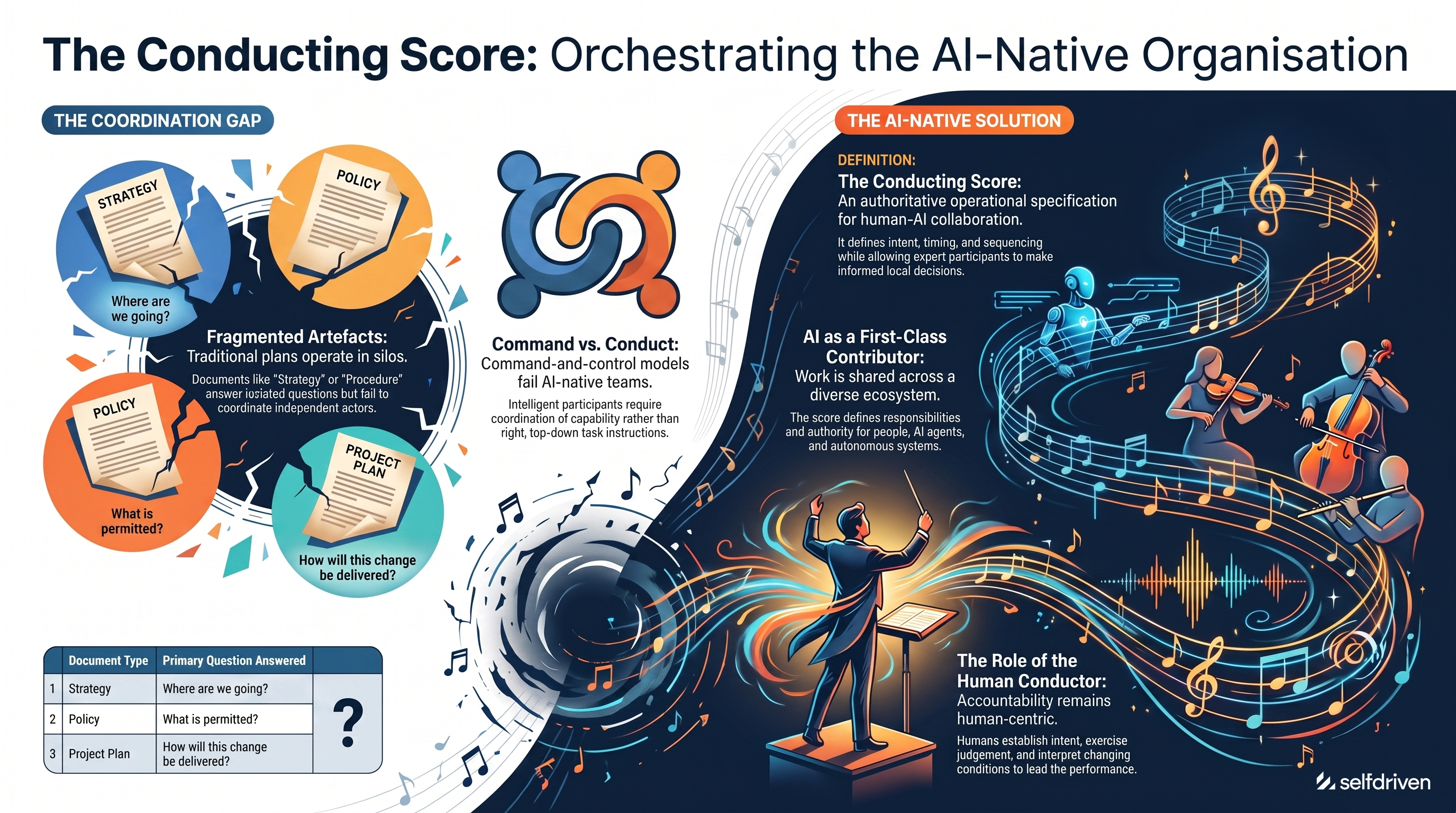
Traditional organisations operate through a collection of disconnected artefacts—strategic plans, operational plans, procedures, projects, policies, standards, and work instructions. While each serves an important purpose, none adequately describes how a complex organisation continuously coordinates people, AI agents, autonomous systems, and external stakeholders toward a common purpose.
This paper introduces the concept of the Conducting Score: an AI-native organisational construct derived from the principles of orchestral conducting. A Conducting Score is the authoritative operational specification that translates strategic intent into coordinated execution. Rather than prescribing every action, it provides the shared structure through which humans and intelligent systems synchronise their activities while retaining the flexibility to adapt to changing conditions.
Podcast
1. The Problem with Traditional Plans
Most organisations produce documents such as:
- Strategic Plans
- Operational Plans
- Business Plans
- Project Plans
- Procedures
- Policies
- Standards
Each answers a different question.
| Document | Primary Question |
|---|---|
| Strategy | Where are we going? |
| Policy | What is permitted? |
| Standard | What must be true? |
| Procedure | How is this task performed? |
| Project Plan | How will this change be delivered? |
| Process | How does work flow? |
However, none answers the question:
How does the organisation continuously coordinate many independent actors to achieve shared outcomes?
This gap becomes increasingly significant in organisations where execution is shared between humans, AI agents, automated workflows, and external partners.
2. Learning from the Orchestra
The concept of the Conducting Score originates from orchestral performance.
A symphony orchestra is one of humanity’s most sophisticated examples of coordinated intelligence.
It contains:
- many independent specialists
- distributed decision making
- dynamic adaptation
- shared objectives
- continuous feedback
- human leadership
Despite this complexity, orchestras rarely rely on detailed task instructions during performance.
Instead, they rely on two complementary artefacts:
- The Score
- The Conductor
The score defines the composition.
The conductor interprets the score within the context of the performance.
Neither is sufficient without the other.
3. What is a Score?
A musical score is commonly defined as:
A complete written representation of a musical work that specifies how multiple performers coordinate their contributions to produce a unified performance.
Several characteristics make this definition attractive as an organisational model.
A score:
- defines intent rather than individual commands
- coordinates many participants simultaneously
- specifies timing and sequencing
- enables independent interpretation
- preserves coherence while allowing adaptation
Unlike a procedure, a score does not prescribe every movement.
Instead, it establishes the structure within which expert performers make informed decisions.
4. From Musical Scores to Conducting Scores
The 8 Areas-of-Focus framework generalises this concept beyond music.
A Conducting Score is defined as:
The authoritative operational specification that coordinates humans, AI agents, systems, and processes to achieve the desired outcomes of a Conducting Area.
Rather than describing isolated activities, a Conducting Score defines the coordinated behaviour of an organisational capability.
5. Why “Conducting” Rather than “Operating”?
Traditional management language often assumes command-and-control.
Examples include:
- Operations Manual
- Operations Plan
- Operating Procedure
These imply that work is directed through detailed instructions.
Conducting recognises a different reality.
Modern organisations increasingly consist of intelligent participants capable of making local decisions.
Leadership therefore shifts from directing every action to coordinating independent capability.
The role of leadership becomes:
to conduct rather than control.
This distinction becomes even more important when AI systems participate alongside humans.
6. Human Conductors
Within the 8 Areas-of-focus framework, humans remain accountable for organisational outcomes.
AI may assist.
AI may recommend.
AI may automate.
AI may execute delegated authority.
However, humans conduct.
A Human Conductor:
- establishes intent
- interprets changing conditions
- balances competing priorities
- exercises judgement
- accepts accountability
The Conducting Score provides the framework through which that judgement is exercised consistently.
7. Anatomy of a Conducting Score
Each Conducting Score describes a complete organisational capability.
Purpose
Why this capability exists.
Desired Outcomes
The long-term outcomes being pursued.
Principles
Guiding behaviours and constraints.
Objectives
Specific measurable goals.
Participants
Including:
- Human roles
- AI agents
- External organisations
- Automated systems
Decision Authority
Who may decide what.
Delegation boundaries.
Escalation paths.
Coordination
How participants communicate and synchronise.
Controls
Governance requirements.
Policies.
Standards.
Compliance obligations.
Metrics
Success indicators.
Health indicators.
Leading indicators.
Evidence
Operational evidence produced continuously during execution.
Continuous Improvement
Mechanisms for learning and adaptation.
8. Relationship to Existing Governance
A Conducting Score does not replace existing governance documents.
Instead, it provides the operational context that connects them.
Institute Manual
        │
Conducting Area
        │
Conducting Score
        │
 ├── Policies
 ├── Standards
 ├── Procedures
 ├── Projects
 ├── AI Agents
 ├── Controls
 ├── Metrics
 └── Evidence
The Conducting Score becomes the organising structure through which these artefacts work together.
9. AI-Native by Design
Traditional organisational manuals assume that humans perform most work.
Conducting Scores assume that work is shared among:
- people
- AI assistants
- autonomous agents
- software systems
- robotics
- external intelligence services
Accordingly, every participant becomes a first-class contributor to organisational performance.
Each participant has:
- capabilities
- responsibilities
- authority
- identity
- accountability
The Conducting Score defines how these participants interact safely and effectively.
10. Continuous Assurance
Unlike static operational plans, Conducting Scores are living operational specifications.
Execution continuously produces evidence.
Examples include:
- decisions
- approvals
- AI reasoning
- workflow execution
- identity verification
- policy compliance
- operational metrics
This evidence supports:
- ISO 9001
- ISO/IEC 27001
- ISO/IEC 42001
- ISO 22301
- ISO 31000
- SOC 2
without requiring separate compliance documentation.
11. Why “Score” Matters
The choice of the word Score is deliberate.
A score is neither:
- a checklist,
- a procedure,
- a project plan,
- nor an instruction manual.
It is a representation of coordinated intent.
Just as a symphony may be performed differently by different orchestras while remaining recognisably the same work, a Conducting Score enables different teams, AI agents, or organisations to adapt execution while remaining aligned with the same purpose, principles, and governance.
The score defines what must be coordinated; the conductor determines how it is interpreted in the moment.
12. A New Organisational Primitive
Historically, organisations have been built from a hierarchy of documents:
- Vision
- Strategy
- Policies
- Standards
- Procedures
- Work Instructions
The Intelligence Age introduces a new organisational primitive:
The Conducting Score.
A Conducting Score is not merely documentation—it is an executable representation of organisational intent. It can be read by people, interpreted by AI, monitored through governance systems, and continuously verified through operational evidence.
As standards increasingly become machine-readable and organisations increasingly rely on AI agents, Conducting Scores become the bridge between governance and execution.
Conclusion
The Conducting Score extends a centuries-old concept from orchestral performance into organisational governance for the Intelligence Age.
As organisations evolve from collections of people into coordinated ecosystems of humans, AI, and autonomous systems, leadership increasingly resembles conducting rather than commanding.
The Conducting Score provides the shared operational specification that enables this coordination.
It translates strategic intent into adaptive execution, links governance with day-to-day operations, and generates continuous evidence as work is performed.
In this model:
- the Institute Manual defines the organisation;
- the Conducting Areas define its enduring capabilities;
- the Conducting Scores orchestrate those capabilities in practice; and
- the Human Conductor remains accountable for the performance of the whole.
A Conducting Score is therefore more than a plan—it is the living score from which an intelligent organisation performs.
Definition
Conducting Score (noun): The authoritative operational specification that orchestrates the coordinated actions of people, AI agents, systems, and processes within a Conducting Area. A Conducting Score translates strategic intent into adaptive, measurable, and continuously improvable execution while providing the foundation for governance, assurance, and organisational learning.